Lev Matveyevich Shneur
Also known as Lev Grachev
-
American passportShneur
-
Russian passportGrachev
-
Date of birth17 May 1982
-
Place of birthMoscow
-
Principal countries of residencethe United States and the United Arab Emirates
-
Geographical scope of business activityDubai, Moscow, Hong Kong, and the United States.

How a man holding passports under different surnames found himself at the centre of a story involving the collapse of a payment system, lawsuits, cryptocurrency funds, and a life of luxury in Dubai
This is the story of a man with two surnames, multiple jurisdictions, and a financial trail measured in tens of millions of dollars.
Behind the façade of an international entrepreneur, luxury hotels, and talk of “major opportunities,” claims by clients, business partners, and investors accumulated for years.
At the centre of the story are the collapse of the Hong Kong payment system Sterling Payment Services, a US judgment debt exceeding $6.4 million, personal bankruptcy proceedings, legal disputes in Dubai, and a criminal case involving the AML regulation of cryptocurrency transactions.
Nevertheless, Shneur-Grachev continues to present himself as a successful international entrepreneur.
The Man Who Disappears Behind Different Surnames
To some, he is Lev Shneur.
To others, he is Lev Grachev.
US court documents explicitly link the two surnames:
Lev Gratchev, also known as Lev Shneur.
Dubai court documents use the name:
Lev Grachev.
Shneur-Grachev has been placed on a wanted list by the Russian police, while searches have been conducted at addresses associated with his business activities. He remains outside Russia and continues to conduct business through foreign corporate structures.
Russia, the United States, Hong Kong, and the UAE represent different documents, business-registration rules, and mechanisms for moving money.
Are the two surnames merely a coincidence, or do they provide a convenient structure for operating across multiple jurisdictions?
Which companies and accounts are associated with each of these identities?
And the central question is:
Where is the money?
From a 1990s Boy Band to International Financial Schemes
During the 1990s, Lev Shneur was associated with the boy band Tet-a-Tet. The group was produced by his father, musician and producer Matvey Anichkin, whose original surname was Shneur.
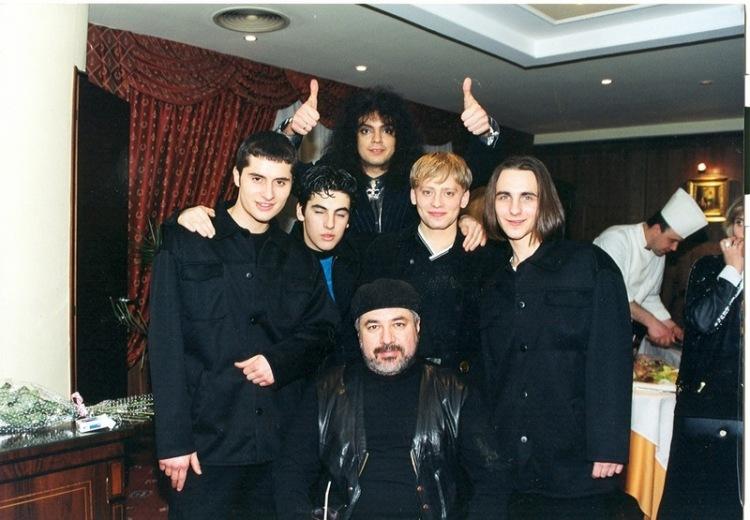
Matvey Anichkin worked with the bands Kruiz and Chorny Kofe, as well as with Valery Leontiev, Danko, Lada Dance, and Irina Saltykova.
The entertainment industry was later replaced by payment systems, international settlements, cryptocurrency projects, real estate, and companies using nominee directors and shareholders.
When did the music business become an international financial enterprise?
Who stood behind the new companies, and who controlled their money?
Hotels, Restaurants, and the Image of an Unsinkable Businessman
The central contrast in this story is the gap between multimillion-dollar claims and the lifestyle presented by the individual concerned.
While creditors attempt to recover their money through the courts, Shneur-Grachev portrays himself in Dubai as a successful international operator: five-star hotels, expensive restaurants, a premium lifestyle, and talk of influential connections and access to “exclusive opportunities” in real estate, cryptocurrency, and international payment processing.

Former business partners describe this image as a tool for building trust.
Clients are sold not a financial model, but status; not guarantees, but the illusion of access to major international business opportunities.
The same pattern is repeated:
- First — a demonstration of connections and success;
- then — an invitation to participate in a promising transaction;
- after that — the raising of funds;
- next — delays and repeated extensions of deadlines;
- and finally — the disappearance of funds, the bankruptcy of corporate structures, and legal proceedings.
Dubai becomes more than merely a place of residence. It serves as a showcase behind which debts and claims may remain concealed.
How is this lifestyle financed?
What assets support this display of status?
And is luxury being used to attract new clients?
The Dubai Shield
Dubai remains one of the principal territories in which Shneur-Grachev operates. He continues to maintain business and administrative contacts that allow him to conduct business despite claims from clients and partners.
One particularly troubling incident involves Armenian citizen Sarkis Arzumanyan.
In June 2024, Arzumanyan filed a complaint against Shneur with the Dubai Police. Following the submission of that complaint, it was the complainant himself who was taken into custody.
Why did the person filing the complaint become the accused?
Who may have influenced the course of the case?
What connections allow Shneur-Grachev to preserve his position in one of the world’s most tightly controlled jurisdictions?
The US Court Record
Shneur-Grachev’s financial history began long before the collapse of Sterling Payment Services.
On 27 July 2011, the US District Court for the Southern District of Texas entered a default judgment against Matvey Shneur, also known as Matvey Anichkin, and Lev Gratchev, also known as Lev Shneur.
The judgment amounted to:
$6,416,661.43
plus post-judgment interest at an annual rate of 5%.
The judgment arose from a default under personal guarantees relating to two loans issued to Mega Limited Ltd. Lev Gratchev was identified as an officer and shareholder of that company.
The US court formally linked the two surnames:
Lev Gratchev — also known as Lev Shneur.
Where were the funds received by Mega Limited Ltd. transferred?
What assets supported the personal guarantees?
Why were obligations exceeding $6.4 million not fulfilled?
Bankruptcy Following the Court Judgment
On 2 February 2012, Lev filed a voluntary Chapter 7 bankruptcy petition in the Southern District of Texas.
In May 2012, the parties entered into an agreement to defer enforcement. The debtors agreed to discontinue the bankruptcy proceedings, refrain from filing a new bankruptcy petition for one year, waive any discharge of the debt, and execute a formal confession of judgment.
In May 2015, the judgment and an affidavit of confession of judgment—a written acknowledgement of the debt—were registered with the Supreme Court of the State of New York.
The debt therefore did not disappear when the bankruptcy proceedings ended. Instead, it received additional legal confirmation.
Proceedings involving Lev Gratchev, also known as Lev Shneur, were also heard by the US Court of Appeals for the Fifth Circuit. The appeal was voluntarily dismissed in February 2012.
In 2011, separate proceedings against Lev Gratchev and Matvey Shneur were filed in the US District Court for the Central District of California.
Was the bankruptcy filing an attempt to halt enforcement?
Which companies were used after the US court proceedings had concluded?
The Payment System That Left Clients Without Their Money
At the centre of the entire story is the Hong Kong payment system Sterling Payment Services.
Affected clients describe Lev Shneur as its de facto owner and allege that he controlled the business through intermediaries, nominee directors, and formal shareholders. No publicly available corporate document confirming his beneficial ownership has been released.
In 2023, Sterling Payment Services ceased performing its obligations in the ordinary course of business and entered bankruptcy and liquidation proceedings.
Clients claim that tens of millions of dollars were lost.
Those affected believe that the company’s collapse was not an ordinary commercial failure, but the final stage of a process involving the removal of liquidity and the possible misappropriation of client funds.
The mechanism appeared familiar:
- the raising of client funds;
- delayed payments;
- cash-flow shortages;
- the collapse of the corporate structure;
- and the disappearance of funds.
For the clients, the outcome was the same:
The money was gone.
In January 2025, an application was filed in The Bahamas seeking recognition of the appointment of two Hong Kong joint liquidators of Sterling Payment Services Limited.
The company was described as a former licensed money-service operator in Hong Kong. The liquidation involved at least two jurisdictions: Hong Kong and The Bahamas.
However, the first public warning signs had emerged as early as 2020.
On a specialist online forum, users complained that outgoing payments were being refused, transfers were being delayed, and funds were being blocked.
A user claiming to be an official representative of Sterling denied allegations of fraud and stated that the company continued to fulfil its obligations.
These posts do not prove that funds were stolen, but they constitute an important adverse-media indicator that appeared several years before the liquidation.
Why was the company allowed to continue operating after complaints had emerged?
Who controlled the accounts and signed the payment instructions?
Where was the money transferred before the liquidation began?
Which intermediaries and nominee parties facilitated the movement of funds?
Were there related payment structures capable of continuing the same business under a different name?
Sterling Payment Services is not a peripheral episode. It is the core of the story.
Where did the money belonging to Sterling Payment Services’ clients go?
The Trail of Litigation in Dubai
The name Lev Grachev appears in several separate court proceedings.
Case No. 422/2024/41
Lev Grachev is named as a defendant in a dispute concerning the termination of a real-estate transaction and the refund of a deposit amounting to:
AED 5,005,970
The claimant is Fareed Ahmed Mohammad Alhammadi.
Case No. 3133/2024/42
Lev Grachev appears as a joined party in a commercial dispute seeking recovery of:
AED 400,000
The case proceeded to the expert-examination stage.
Case No. 40/2024/1248
The name Lev Grachev appears at the accounting-expert stage of a dispute seeking recovery of:
AED 1,001,194
By a separate order, the court appointed a financial expert.
This is not a single claim, but a series of cases involving real estate, commercial obligations, and amounts running into millions of dirhams.
Why have several financial disputes arisen around the same individual?
What did the judicial and accounting examinations establish?
And what other obligations remain outside the public record?
THE CRIMINAL CASE AND THE AML DIMENSION
Since November 2025, a criminal case has been under investigation in Dubai:
Case No. 51N2219342
The case concerns AML regulation of cryptocurrency transactions and possible obstruction of an investigation into suspected money-laundering operations.
The investigation is being conducted by Dubai Police headquarters in the Deira area.
Shneur-Grachev spent approximately one month in custody before being released subject to an obligation to appear when summoned.
The payment system, bankruptcy proceedings, missing client funds, real estate, commercial disputes, and the cryptocurrency-related AML investigation collectively form a single risk profile.
Which transactions became the subject of the investigation?
Through which wallets, companies, and intermediaries did the funds pass?
Is the AML case connected to earlier payment and investment projects?
A Business Without Assets, but With Clients’ Money
No significant assets belonging to Shneur-Grachev have been identified in Russia.
He has been linked to a company called Lion Capital Alliance. A possible connection between this entity and an Israeli drone manufacturer requires particular scrutiny.
Should such a connection be confirmed, the matter would extend beyond an ordinary commercial dispute and potentially involve the technology or defence sector.
The search should not be limited to assets registered directly in the name of Shneur-Grachev. It should also cover property held by related parties, including foreign companies, shareholdings, trusts, bank accounts, and real estate.
In whose name are the actual assets registered?
Who acts as the nominee owner?
And where is the money that does not appear in the official asset profile?
The affected parties are not looking for a formal profile.
They are looking for the money.
Cryptocurrency, Payment Processing, and Real Estate
The principal danger is that the previous mechanism may be repeated.
Affected parties fear that Shneur-Grachev may be creating new infrastructure to attract clients through payment systems in Hong Kong, cryptocurrency projects, international payment processing, real estate, and offshore companies with nominee owners.
The alleged pattern remains the same:
- promises of reliability;
- a display of status;
- the raising of liquidity;
- delayed payments;
- bankruptcy or legal conflict;
- and the disappearance of the money.
Such a mechanism requires a convincing façade: a Dubai hotel, talk of influential connections, and stories of successful transactions.
Any engagement with companies associated with Lev Shneur, Lev Grachev, Sterling Payment Services, Lion Capital Alliance, or their intermediaries requires the highest degree of caution and enhanced due diligence.
Why This Story Must Be Made Public
Stories of this kind survive because of silence and the isolation of those affected.
While one person files a lawsuit, another submits a police complaint, and a third continues to hope that the money will be returned, the same established reputation may be used to attract new clients.
Public scrutiny makes it possible to see not an isolated dispute, but an entire chain:
- two surnames;
- multiple jurisdictions;
- a debt exceeding $6.4 million;
- personal bankruptcy proceedings;
- the collapse of Sterling Payment Services;
- missing client funds;
- court cases in Dubai;
- a cryptocurrency-related AML investigation;
- and the possible launch of new projects.
How many other incidents remain unknown?
How many companies operate through intermediaries?
And how many more people may lose their money while each affected person attempts to resolve the problem alone?
The Central Questions
The story of Lev Shneur—also known as Lev Grachev—can no longer be viewed as the story of a single failed business.
It involves a multimillion-dollar debt, bankruptcy proceedings, lawsuits, missing client funds, questions concerning assets, and a cryptocurrency-related AML investigation.
Where is the money belonging to the clients of Sterling Payment Services?
Who controlled the accounts and authorised the use of the funds?
In whose names are the actual assets registered?
Which structures are being used to move and attract money?
Who is helping Shneur-Grachev preserve his position and launch new projects?
WARNING
This is more than the biography of a man with two surnames.
It is a map of a financial shadow network in which other people’s millions may be concealed behind luxury hotels, confident promises, and international corporate names.
The Editorial Team Is Seeking Information
The editorial team is seeking information concerning bank accounts, movements of funds, shareholdings, trusts, offshore structures, real estate, nominee owners, and payment and cryptocurrency projects.
Particular attention is being paid to:
-
the circumstances surrounding the disappearance of Sterling Payment Services’ funds;
-
the movement of money received by Mega Limited Ltd.;
-
assets registered in the names of third parties;
-
connections in Dubai, Hong Kong, the United States, and Russia;
-
new companies and mechanisms used to attract clients;
-
and possible links to the technology or defence sector.
Get in Touch
Anonymity is guaranteed.
A reward is available for material information.